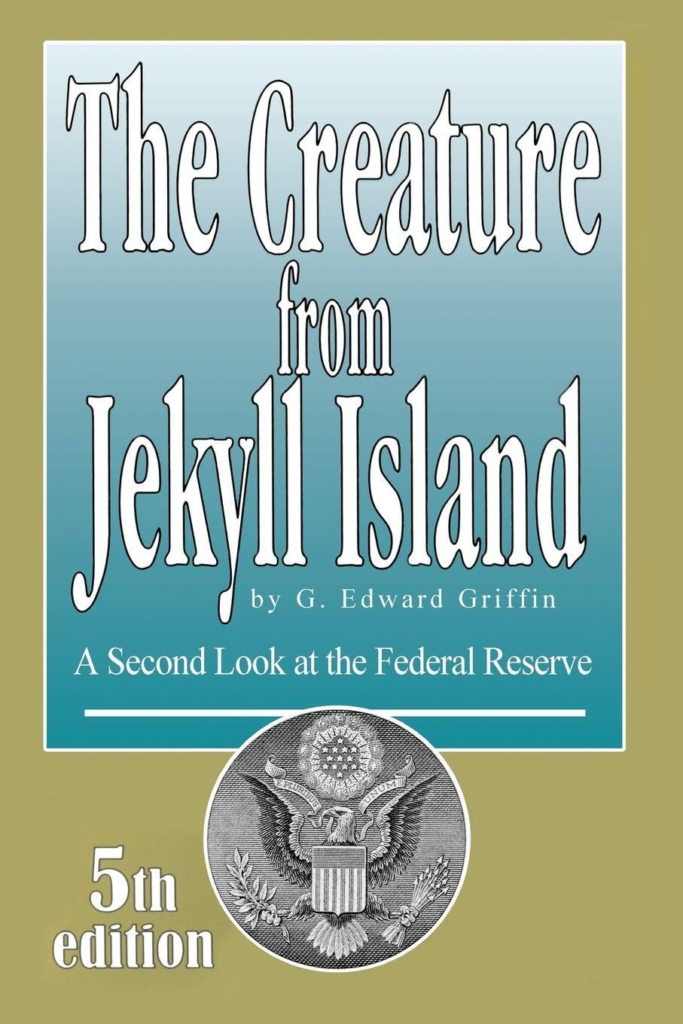
Get The Creature from Jekyll Island from Amazon.
The Creature from Jekyll Island is the kind of book that leaves readers feeling as though a curtain has been pulled back on the modern financial world. Across countless reviews, people describe it not merely as a history book about banking or the Federal Reserve, but as a transformative and deeply unsettling examination of money, power, debt, inflation, and political influence. Readers consistently portray the book as both educational and alarming — a work that reframes how they view governments, banks, war, economics, and even daily life itself.
One of the strongest recurring themes is the idea that the book makes complicated financial systems understandable to ordinary readers. Many praise G. Edward Griffin for taking subjects that are usually dry, technical, and inaccessible — central banking, fiat currency, inflation, fractional reserve banking, monetary policy, debt structures, and the Federal Reserve System — and turning them into something engaging, coherent, and even suspenseful. Readers repeatedly emphasize that the book reads less like an economics textbook and more like a political thriller or historical exposé. Even people who admit they previously knew little about finance say the book fundamentally changed their understanding of how money is created and controlled.

Readers are especially struck by the book’s central claim that modern fiat money is not “real” in the traditional sense, but rather debt created through lending and banking systems. Multiple readers describe being shocked by explanations of how banks create money “out of thin air,” lend far beyond their actual reserves, and profit from interest on currency that did not previously exist. The Federal Reserve is repeatedly characterized in the reviews as less of a public institution serving citizens and more as a privately influenced banking cartel designed to consolidate power and wealth. Readers frequently express anger or disbelief at the notion that inflation is not simply an unfortunate side effect of economics, but something structurally built into the monetary system itself.
Another major element praised throughout is the historical depth of the book. Readers note that Griffin traces the development of modern banking from early goldsmiths and paper receipts all the way to central banking systems, the creation of the Federal Reserve, the IMF, Bretton Woods, global lending institutions, and international finance. Many reviewers appreciate that the book attempts to connect seemingly isolated events — banking crises, wars, inflation, political shifts, bailouts, and economic collapses — into one broader narrative about centralized financial power. Several reviewers emphasize that the book heavily cites primary sources, speeches, historical quotations, and documentation, which gives the work an appearance of rigorous research even among those who disagree with its conclusions.
Emotionally, the reactions are intense. Readers repeatedly describe the experience as “eye-opening,” “disturbing,” “world-altering,” “infuriating,” and “life-changing.” Some say the book made them angry at governments and financial institutions, while others describe sadness, fear, or a sense of betrayal after realizing how inflation and debt systems affect savings, wages, pensions, and the middle class over time. Several argue that the book explains why wealth inequality grows, why the middle class struggles, and why financial crises seem cyclical and unavoidable under the current system. Others say it changed how they think about investing, saving money, voting, and evaluating political candidates.
The book has become so influential within anti-central banking, libertarian, hard-money, and populist financial circles. Readers often connect the book to concerns about globalism, international banking institutions, government overreach, debt-driven economies, endless war financing, and perceived collusion between political elites and major banks. Some go much further, interpreting the book as evidence of coordinated manipulation by powerful financial dynasties and institutions. Others focus less on conspiracy and more on structural critiques of fiat currency and inflationary monetary policy. Regardless of where individual reviewers land politically, the overwhelming consensus is that the book provokes skepticism toward centralized financial authority.
Many of the strongest endorsements come from readers who already distrust central banking systems or who feel alienated by modern economic realities. Some openly admit they did not independently verify every claim or footnote, but nevertheless found the narrative compelling and persuasive. The emotional power of the book clearly comes not only from the historical claims it makes, but from how it weaves economics into a larger moral and civilizational story about freedom, corruption, debt, power, and societal decline.
Ultimately, The Creature from Jekyll Island is viewed by its admirers as far more than a book about banking. To them, it is a warning about how financial systems shape politics, culture, war, class structure, and personal freedom. Whether readers come away agreeing with every argument or not, many describe the experience as one that permanently changes how they see money and the institutions behind it. The common thread is this: after reading the book, people feel they can no longer look at the modern financial world the same way again.